Frequently Asked Questions

These Questions and Answers pertain mainly to Sleep Pro 1’s.

Go to the main User Information Page

Should I Use a Dentist to Take My Impression?

We have designed our products so they can be fitted without a dentist. However, if you are happy to spend the money, there is no reason why you should not involve a dentist. Your dentist could take your impression for you, or he could simply give his opinion about whether or not your teeth are suitable for mandibular advancement – specifically, he could answer the question: are there any obvious reasons why you should not wear a mandibular advancement splint. It is worth noting that many of our customers successfully fit a Sleep Pro 1 and take a Sleep Pro 2 impression without any input from their dentist. However, if you have a non-standard bite or irregular teeth, then it may be best to get your dentist involved.

How and Why Does it Work?

The most common cause of snoring is air being passed through a partially constricted airway causing vibration of the palate during breathing. Moving the jaw forward opens up the airway and stretches the palate so it does not vibrate (or vibrates less). 

How long does it take before we know it works?

You (or more likely, your partner) will know within minutes of you falling asleep whether or not it works for you. If it stops you snoring for even a short while, then you know that moving your jaw forward works for you. The task then is to find the right mouthpiece for you. Some people use a boil-and-bite mouthpiece for months, before converting to a custom made one. Some people literally try one for a few hours and then go for a custom-made one. Some people only use a Sleep Pro 1.

If it does not work straight away, then do not persevere in the hope that it will work better in time. If it does not work straight away, then it needs “tweaking”. If you follow the guidelines below, then you have a very good chance of getting it to work. Please feel free to contact us to discuss what to do next if you find yourself in this situation. People are understandably disappointed to find their Sleep Pro 1 does not work, but are then pleasantly surprised to find that with a bit of “tweaking” they stop snoring. The reasons for this will become clearer as you read on and you will be pleased to know there is nothing here you can’t do yourself and that we are more than happy to answer any questions you have to help you on your way. 

Reasons why your Sleep Pro 1 doesn’t work and what to do about it:

If it does not work the first time, then don’t give up hope as there are several things that can be done.

Problem: It doesn’t work. 

Possible solution- the two most common causes and solutions are:

(i) your jaw may not be pushed far enough forward, so remould the mouthpiece with your jaw further forward. Note: pushing your jaw further forward reduces snoring, but increases discomfort. We are trying to find a position where your jaw is far enough forward to stop you snoring, but not so far forward that it causes discomfort. It can be a process of trial-and-error, but when you find the right spot, the rewards are worth it. 

(ii) Your jaw may be slipping out of the mouthpiece and so your jaw is not held forward while you are asleep. See the suggestions below.

Problem:

(i) It only stops me snoring at the beginning of the night.

(ii) It’s fine to begin with, but then my jaw drops out and I start snoring again.

(iii) I wore it when I went to sleep. I didn’t snore to begin with, but then I did and woke up with it on the pillow.

Problem:

(i) It only stops me snoring at the beginning of the night.

(ii) It’s fine to begin with, but then my jaw drops out and I start snoring again.

(iii) I wore it when I went to sleep. I didn’t snore to begin with, but then I did and woke up with it on the pillow.

Possible solution: It may be dropping out of your teeth while you are asleep. This is a common problem with "boil-and-bite" mouthpieces and may be overcome by (i) reheating and remoulding it and (ii) sucking out the saliva, particularly when you first put it in each night. A custom-made mouthpiece like our Sleep Pro 2, may be the solution as they grip the teeth much better. Another approach is to use something to hold the jaw closed while asleep. We have developed the Sleep Pro Chin Strap to gently hold the jaw closed while asleep. For more information, please click here.

If you wore a Sleep Pro 1 and it worked, even if only for a few minutes, then it has told us something very worthwhile, even though this may not seem obvious at first. The device has confirmed that moving your jaw forward a short way stops you snoring, and it has done so without you having to spend a lot of money.  If the Sleep Pro 1 works fine for you, even if need a chin cushion, then that is all you may need. If it only works for part of the time, or is uncomfortable, then you should get a custom-made Sleep Pro 2.

Problem: it used to work, but now I’m snoring again.

Possible solution: It may have stretched and so you should (i) remould it, or (ii) buy a new one, or (iii) upgrade to a custom-made device like a Sleep Pro 2.

Problem: my jaw muscles hurt when I wake in the morning (TMJ pain).

Possible solution: your jaw may be pushed too far forward and so you may need to remould the mouthpiece with your jaw not so far forward. 

Problem: my front teeth hurt when I wake in the morning.

Possible solution: lots of people experience this when they start using a Sleep Pro 1 and they usually find it goes away after they have been using it for a few days to a couple of weeks. It could also be that your jaw is pushed too far forward, so try remoulding the mouthpiece with your jaw not so far forward. Or upgrade to a Sleep Pro 2. With a Sleep Pro 1 the pressure caused by your jaw trying to move back into place is pushed onto your front teeth, whereas with a Sleep Pro 2 the same “load” is put onto nearly all your teeth and so it is not so noticeable, or is non-existent. 

How many times can I remould my Sleep Pro 1?

You can remould your Sleep Pro 1 as many times as you like, but after the fourth or fifth time it will become less malleable.

When I wake in the morning and remove the mouthpiece, my jaw feels as though it is pushed forward.

This is a common experience. While it can take some people a little while to get used to, you will find that your jaw will move back into place quite naturally and comfortably, shortly after you remove the mouthpiece. The longer you use a mouthpiece the more accustomed to this sensation you will become and the less you will notice it.

Will I be able to wear it all night?

We find that some people can keep one in place all night with no problems and others, not many but a few, find they can only wear it for part of the night. If this is the case for you, then try reheating and remoulding the Sleep Pro 1 for a better fit (if you need the instructions we’ll gladly email or post them to them to you). Most people get used to wearing one within a few days to a couple of weeks.

Try upgrading to a Sleep Pro 2. These are made using a dental impression kit that provides a near perfect fit to your teeth and reduces substantially the likelihood of it dropping out of your mouth while you are asleep. They are also more comfortable.

Some people find they cannot sleep with a mouthpiece in their mouth. If this is the case for you, it is worth noting that people get used to wearing a mouthpiece with time.

Will it work for me?

One way to find out it is to try. Some people have no problems at all and others do. This is one of the reasons we suggest trying a cheap one first. It works for most users, even though it may need a bit tweaking to get it right. A “boil-and-bite” splint like a Sleep Pro 1 has a narrower range of possible jaw advancement than an adjustable custom-made splint fitted by a dentist. While this narrower range is fine for most people, there will be a small percentage who try a boil-and-bite and are disappointed to find it doesn’t work – even after they have tweaked it. It may be because it does not advance their jaw far enough forward. If a “boil-and-bite” splint does not work for you (and, by the way, it probably will – see our section on what to do if it doesn’t work), then there is still hope in the idea that your dentist may be able to help you with an adjustable custom made splint (these will be 2 - 5 times more expensive than our Sleep Pro 2).

My Wisdom Teeth are pressing against my gums when I push my jaw forward and are causing pain and discomfort.

If this is happening, then you should stop using the device and consider seeing your dentist – who will advise you on the most appropriate course of action. It may be that your wisdom teeth are stopping you pushing your jaw forward and this is, indirectly, making your snoring worse. You may wish to weigh-up the pros and cons of having your wisdom teeth removed.

My Sleep Pro 1 is very rough:

If you place a Sleep Pro 1 in water that is too hot, it becomes very rough and unwearable and needs to be replaced. It is worth noting that it loses some of its smoothness when put in hot water - even at the right temperature. The Sleep Pro 2, on the other hand, is very smooth. 

What about Sleep Apnoea and CPAP?

Most people with Obstructive Sleep Apnoea (OSA) snore, but only a small minority of snorers have OSA. If your partner has noticed pauses in your breathing whilst you sleep, or if you have significant daytime tiredness, then you should mention this to your doctor and ask about a sleep study.

Both CPAP and mandibular advancement splints are valid treatment for certain cases of OSA, but this must be supervised by a physician knowledgeable in the area.

What types of mandibular advancement splints are there out there?

There are three levels of mandibular advancement splints: 

(i) inexpensive boil-and-bite splints like Sleep Pro 1’s.

(ii) Custom-made splints like Sleep Pro 2’s, that are not adjustable.  A Sleep Pro 2 is about 1/3rd of the price of an adjustable custom-made splint.  

(iii) Adjustable custom-made splints that cost between £240 and £600.

I breathe through my mouth when I am asleep, will I be able to wear a Sleep Pro?

Yes. We have engineered large breathing holes into both the Sleep Pro 1 and 2. 

It is normal for your nose to become more blocked for a while when you first lie down.  This is due to a change in blood pressure in the vessels around the nose.  However, the body soon compensates and normally within fifteen minutes everything reverts to normal and you should be able to breathe the same lying down as you can sitting up.

How long will a Sleep Pro last?

Sleep Pro products are relatively new and we do not have long term data to confirm how long they last. However, we expect they should last anywhere between a couple of months and 18 months depending upon factors like whether you grind your teeth while asleep.

Will it be too bulky for me?

Some people find them too bulky and others do not. The Sleep Pro 2 is much less bulky than the Sleep Pro 1.

Will it work if I have dentures?

We have numerous customers with dentures, some have had a successful outcome and some have not. 

Most of the "load" is taken on the front teeth with a Sleep Pro 1, so if these teeth are intact, then you may be OK. If not, then you might be best to try a Sleep Pro 2 impression (see below) for one night to see if a custom made mouthpiece will work for you.

What is a Sleep Pro 2 Impression Kit?

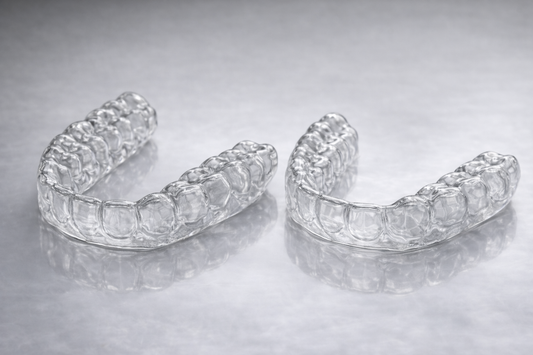
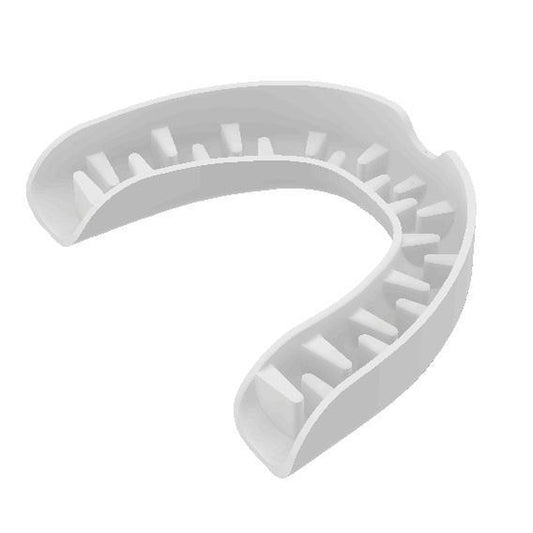
A Sleep Pro 2 impression kit is comprised of an impression tray (which is a Sleep Pro 1 with holes to accommodate dental putty) and two containers of dental putty that go hard when mixed together. The impression kit is used to take a near perfect impression of your teeth and is used to make a Sleep Pro 2 in our lab. 

What is the difference between a Sleep Pro 1 and a Sleep Pro 2?

The Sleep Pro 1 is considerably cheaper than the Sleep Pro 2.

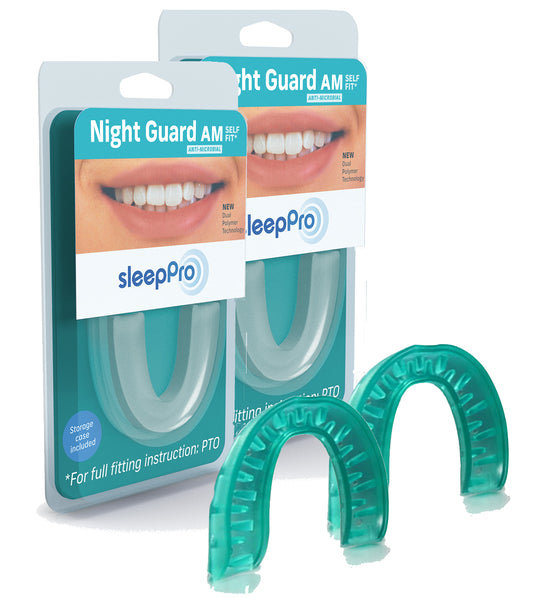
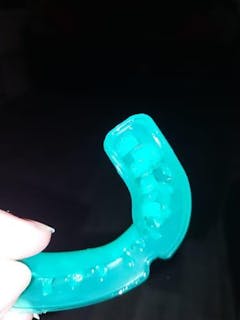
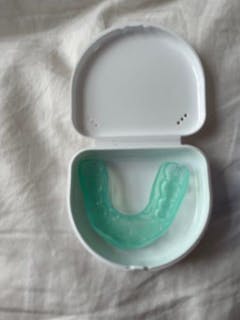
The Sleep Pro 1 is a “boil-and-bite” mouthpiece, which means you put a thermo-plastic mould in hot water and then bite into it so that it takes the shape of your teeth. The Sleep Pro 1 is not customised, but it does provide a very good fit for a “boil-and-bite” mouthpiece.

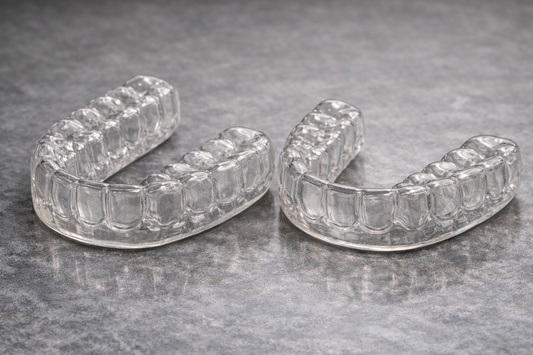
The Sleep Pro 2 is customised and hand-made in a laboratory. The Sleep Pro 2 is made using a dental impression kit. You can take the impression yourself, or get your dentist to do it. It takes a perfect impression of your teeth.

The Sleep Pro 2 has thinner walls and so is less bulky and you are less aware of it when you wear it.

The Sleep Pro 1 grips mainly the front teeth. The Sleep Pro 2 grips all the teeth – which is why it is more comfortable and why it stays on your teeth while you are asleep (whereas a Sleep Pro 1 is more likely to fall off the teeth). 

My Doctor Said …

As a general rule it is always best to follow the advice of your doctor or dentist as they know what is best for you.

Go to the main User Information Page

Stop Snoring with Sleep Pro
The most effective low cost stop snoring solution